I Only Feel That
Use the uploaded reference image as the PRIMARY VISUAL REFERENCE and the user's subsequently uploaded personal photo as the PRIMARY and ONLY IDENTITY REFERENCE for the male subject. Recreate the reference photograph as closely and realistically as possible while replacing the original male subject's identity with the recognizable identity of the person from the user's personal photo. Preserve the user's authentic facial identity naturally and consistently, including his face shape, forehead, hairline, eyebrows, eye shape, eyelids, eye spacing, nose structure, cheeks, cheekbones, lips, mouth shape, chin, jawline, ears, natural skin texture, facial proportions, subtle asymmetry, and all distinctive identifying characteristics. Do not beautify, redesign, idealize, or transform his face into another person's appearance. The final male subject must clearly remain the same recognizable person from the uploaded personal photo.
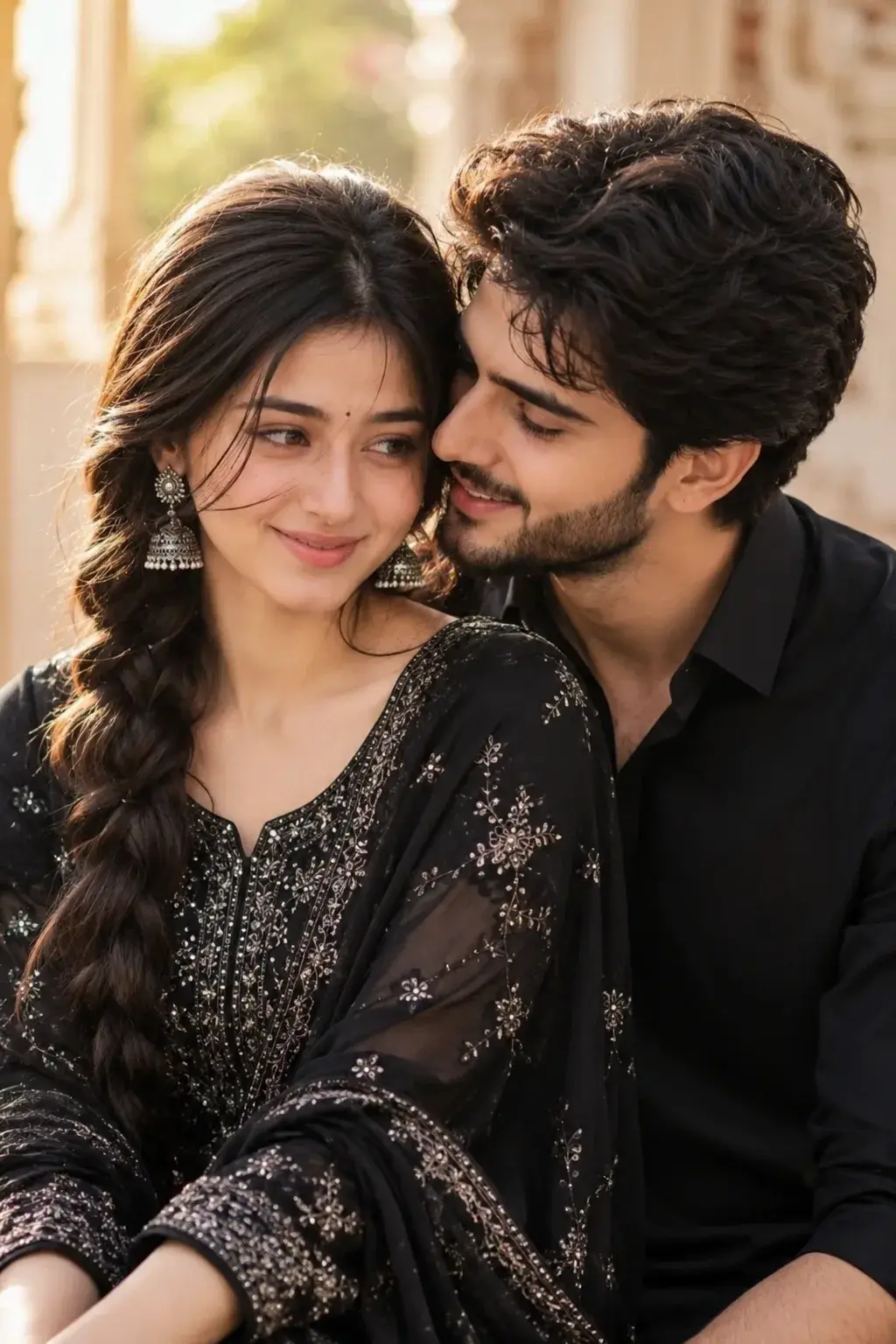
Recreate the reference scene as a highly realistic intimate romantic indoor portrait: the male subject is seated or leaning in from the lower-left foreground, wearing a dark black shirt, with slightly tousled dark hair falling naturally around his forehead and ears. The female subject is positioned closely beside and above him on the right side of the composition, leaning toward him in a tender romantic moment. Her face is very close to his face, their noses and lips nearly touching in a natural near-kiss, with an emotionally intimate and affectionate atmosphere. Preserve the exact spatial relationship between both subjects, including the distance between their faces, the woman's upper-body lean, the man's seated posture, the woman's arm extending across toward the man's face, and her hand gently cupping the side/back of his jaw and cheek. Preserve the natural placement of fingers, wrist, forearm, elbow, shoulders, neck, and torso, with anatomically correct joints and realistic physical contact. Maintain the same romantic body language without exaggeration.
Preserve the reference's facial-expression dynamics precisely: the male subject should retain the soft, intimate expression and upward gaze toward the female subject, with relaxed eyelids, natural lips, relaxed jaw, and subtle romantic emotion; the female subject should retain the gentle affectionate expression, soft eyes directed toward the male subject, relaxed eyebrows, naturally parted or softly closed lips, relaxed jaw, and delicate romantic micro-expression. Treat head direction, face orientation, and eye gaze as separate anatomical elements and reproduce them accurately. The male head must be naturally tilted upward and toward the female subject rather than appearing front-facing; his eyes must follow the female subject's face. The female head must be naturally angled downward and toward him, with her eyes directed toward him. Both faces must physically follow their three-dimensional head orientations, with realistic perspective, facial foreshortening, nose projection, cheek visibility, jawline visibility, ear visibility, eye spacing, eyelid positioning, and facial asymmetry. Never paste a frontal face onto a rotated head.
Make the head, neck, shoulders, and torso behave as one connected anatomical structure. Reproduce the natural neck angles created by the intimate pose, with realistic connection between jaw, chin, neck, trapezius, and shoulders. Where the head is tilted or rotated, create only subtle realistic skin compression, stretching, and natural folds caused by the pose. No broken, twisted, stretched, disconnected, rubber-like, or damaged neck anatomy. Maintain realistic head-to-body, head-to-neck, neck-to-shoulder, shoulder-to-torso, and arm-to-body proportions. The male's head must not become oversized because of identity preservation, and neither subject should have distorted body proportions.
Recreate the female subject's overall visual styling from the reference without transferring her personal identity to the male. Preserve the reference's hairstyle characteristics as visual styling where appropriate: dark hair gathered into a loose high bun with naturally escaping strands framing the face, soft flyaway hairs, and realistic individual hair texture. Preserve the elegant light-colored sleeveless/strappy outfit, delicate jewelry, natural makeup appearance, and understated styling visible in the reference. Preserve the male subject's dark clothing and naturally messy dark hairstyle as visual elements while ensuring the male's actual identity comes exclusively from the uploaded personal photo. Do not transfer recognizable identity-specific facial characteristics from the reference male.
Recreate the exact indoor environment and photographic atmosphere of the reference: an upscale modern room or hotel-like interior at night, warm ambient interior lighting, a softly illuminated lamp toward the left background, dark marble or dark architectural surfaces, large floor-to-ceiling windows behind the subjects, and a softly blurred nighttime city skyline visible outside with scattered illuminated buildings and window lights. Maintain the same spatial depth and environmental relationship between the couple and the background. Preserve the warm intimate mood created by the combination of warm interior light and cooler bluish city lights outside.
Match the reference composition precisely: vertical portrait framing, close-up/medium-close intimate crop, male subject occupying the lower-left portion of the frame, female subject dominating the right and upper-right portion, both faces positioned prominently near the center-left/center area, woman's upper torso and arm visible, male's upper torso visible in the lower portion, and the city skyline occupying the background through the windows. Preserve the same negative space, subject placement, crop, visual balance, and camera-to-subject distance. Do not randomly reposition either person or change the scene into a generic romantic portrait.
Reproduce the reference camera perspective and photographic characteristics, resembling a high-end full-frame DSLR or mirrorless portrait photograph captured with a natural short-telephoto portrait lens around 50–85mm, with realistic lens compression, natural perspective, moderate shallow depth of field, crisp facial detail, and softly defocused background lights. Keep both faces naturally detailed while allowing the distant city skyline, lamp, furniture, and background architecture to fall into realistic optical blur. Create natural bokeh rather than artificial digital blur, with physically plausible light circles and smooth depth transitions. Maintain realistic edge separation around hair without halos or cutout artifacts.
Recreate the lighting exactly in spirit and direction: warm soft interior illumination falling naturally across the subjects' faces and bodies, gentle highlights on skin, subtle shadows beneath the chin and around the jaw and neck, soft reflected ambient light from the room, and cooler bluish city illumination visible through the windows. Ensure every highlight and shadow follows the actual three-dimensional orientation of each head, neck, arm, hand, and torso. Skin must remain naturally rendered with visible fine pores and realistic tonal variation, never plastic or waxy. Preserve realistic skin translucency, subtle facial texture, fine hair detail, natural lips, realistic eyes, fabric texture, jewelry reflections, and physically plausible light falloff.
Match the reference color palette and grading: warm beige, cream, soft brown, black, and muted neutral interior tones contrasted subtly by cool blue and white nighttime city lights. Maintain natural skin tones, gentle contrast, slightly soft cinematic exposure, restrained saturation, realistic blacks, smooth highlights, and a premium intimate editorial-photography appearance. Avoid excessive orange skin, whitening, oversaturation, HDR, crushed shadows, or artificial cinematic filters.
Create a completely photorealistic result that looks like an authentic professionally captured photograph rather than AI artwork. Preserve realistic anatomy, natural contact between hands and face, correct finger count and finger joints, believable skin compression where the woman's hand touches the man's cheek and jaw, realistic hair interaction, physically correct clothing folds, and coherent depth relationships. Every element must obey real-world anatomy and photographic physics: HEAD → NECK → SHOULDERS → TORSO, FACE → HEAD ORIENTATION → EYE GAZE, EXPRESSION → EYES → EYEBROWS → MOUTH → FACIAL MUSCLES, and CAMERA → PERSPECTIVE → FACIAL FORESHORTENING → BODY PROPORTIONS. Produce extremely detailed 4K-quality photographic realism with natural pores, individual hair strands, realistic eyes, realistic lips, authentic fabric fibers, subtle skin imperfections, accurate shadows, realistic bokeh, and professional DSLR/mirrorless image quality.
Strictly avoid any identity change, generic AI face, celebrity resemblance, model-like replacement face, beautified identity, plastic skin, waxy skin, CGI appearance, cartoon or anime styling, frontal face pasted onto a rotated head, incorrect head rotation, incorrect neck orientation, broken neck, twisted neck, floating head, disconnected jaw, malformed anatomy, oversized head, oversized face, tiny neck, unnatural body proportions, distorted shoulders, unnatural hands, extra fingers, missing fingers, fused fingers, malformed fingers, crossed eyes, incorrect eye gaze, mismatched eye direction, distorted eyes, distorted nose, distorted lips, distorted jaw, asymmetrical facial distortion, artificial facial symmetry, excessive smoothing, beauty filters, fake skin, excessive sharpening, excessive HDR, unrealistic lighting, impossible shadows, fake bokeh, cutout edges, hair halos, duplicated limbs, warped clothing, floating objects, background replacement errors, low resolution, excessive blur, noise, compression artifacts, or any visible AI-generation defects. Th